The Hidden Cost of Manual Business Processes and How Digital Transformation Solves It
In today's competitive business environment, organizations are constantly searching for ways to improve efficiency and reduce operational costs. While many businesses focus on increasing sales and expanding their customer base, they often overlook a major challenge hiding within their daily operations: manual business processes. Tasks that rely on spreadsheets, paperwork, emails, and repetitive data entry may seem manageable at first, but as a company grows, these processes can become significant obstacles to productivity and profitability.
Why Manual Processes Hold Businesses Back
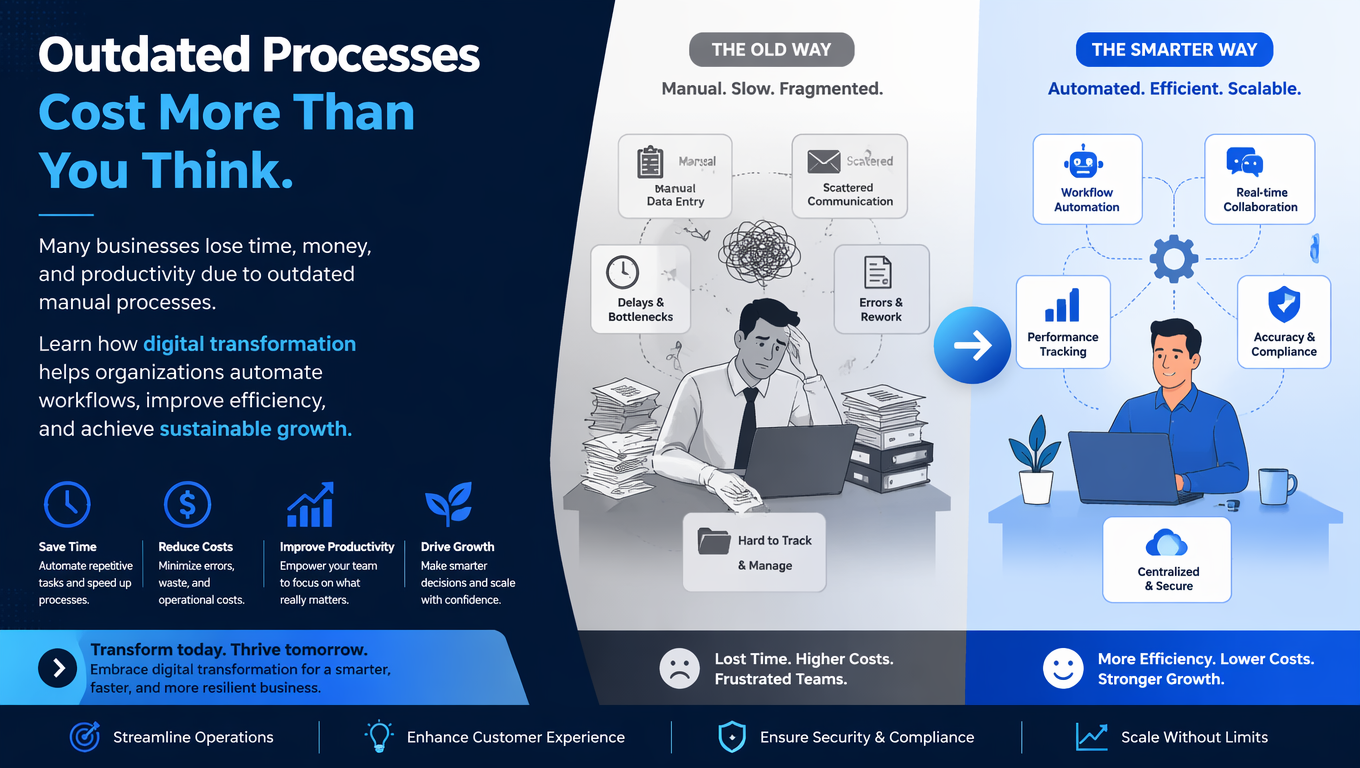
Many organizations continue to rely on traditional methods because they are familiar and easy to implement. However, manual processes often lead to delays, human errors, duplicate work, and communication gaps between departments. Employees spend valuable time performing repetitive tasks instead of focusing on activities that contribute directly to business growth.
As operations expand, the complexity of managing information manually increases. This creates bottlenecks that slow decision-making and reduce overall organizational efficiency.
The Financial Impact of Inefficiency
Every minute spent on repetitive administrative work represents a hidden cost to the business. Employees who manually update records, process requests, or compile reports consume resources that could be used more strategically. In addition, human errors can lead to financial losses, customer dissatisfaction, and compliance risks.
Organizations that fail to modernize their workflows often experience increased operational expenses while struggling to keep up with competitors who embrace digital solutions.
Automation Creates Faster Workflows
Digital transformation enables businesses to automate routine processes that traditionally require significant manual effort. Workflow automation can handle approvals, notifications, data processing, reporting, and task assignments with minimal human intervention.
Automated systems ensure consistency, reduce processing times, and allow employees to focus on high-value responsibilities. This leads to improved productivity across departments and better utilization of organizational resources.
Better Data Leads to Better Decisions
Data is one of the most valuable assets a business can possess. However, when information is stored across multiple spreadsheets, emails, and paper documents, gaining meaningful insights becomes difficult.
Digital platforms centralize information and provide real-time access to critical business data. Decision-makers can monitor performance metrics, identify trends, and make informed strategic decisions based on accurate information rather than assumptions.
Enhancing Collaboration Across Teams
Communication challenges often arise when teams rely on disconnected systems and manual processes. Digital solutions create a centralized environment where departments can collaborate efficiently, share information instantly, and track progress in real time.
Improved collaboration reduces misunderstandings, accelerates project completion, and strengthens overall organizational performance.
Improving Customer Experience
Customers expect fast responses, accurate information, and seamless service. Businesses that depend on manual processes frequently struggle to meet these expectations due to delays and inefficiencies.
Digital transformation enables organizations to respond more quickly to customer inquiries, process requests efficiently, and deliver a more professional customer experience. Improved service quality leads to stronger customer relationships and increased loyalty.
Scalability for Future Growth
As businesses grow, operational complexity increases. Processes that worked for a small team may become unmanageable at a larger scale. Digital solutions provide the flexibility needed to support expansion without significantly increasing administrative overhead.
Organizations can handle higher workloads, manage larger datasets, and support growing customer demands while maintaining operational efficiency.
Strengthening Business Competitiveness
Companies that embrace digital transformation gain a significant competitive advantage. Faster operations, improved accuracy, enhanced customer experiences, and data-driven decision-making help organizations adapt quickly to changing market conditions.
Businesses that continue relying on outdated processes risk falling behind more agile competitors that leverage technology to drive innovation and efficiency.
The Future Belongs to Digitally Enabled Businesses
Digital transformation is no longer a luxury reserved for large enterprises. Businesses of all sizes can benefit from automation, centralized data management, and streamlined workflows. Organizations that invest in modern technology today position themselves for sustainable growth, improved productivity, and long-term success in an increasingly digital world.