Inventory Management Software: A Complete Guide for Modern Businesses
Managing inventory efficiently is essential for businesses that sell, store, distribute, or manufacture products. Maintaining too much stock can increase storage costs, while insufficient inventory can result in missed sales and unhappy customers. As businesses grow, tracking products manually through spreadsheets or paper records can become increasingly difficult.
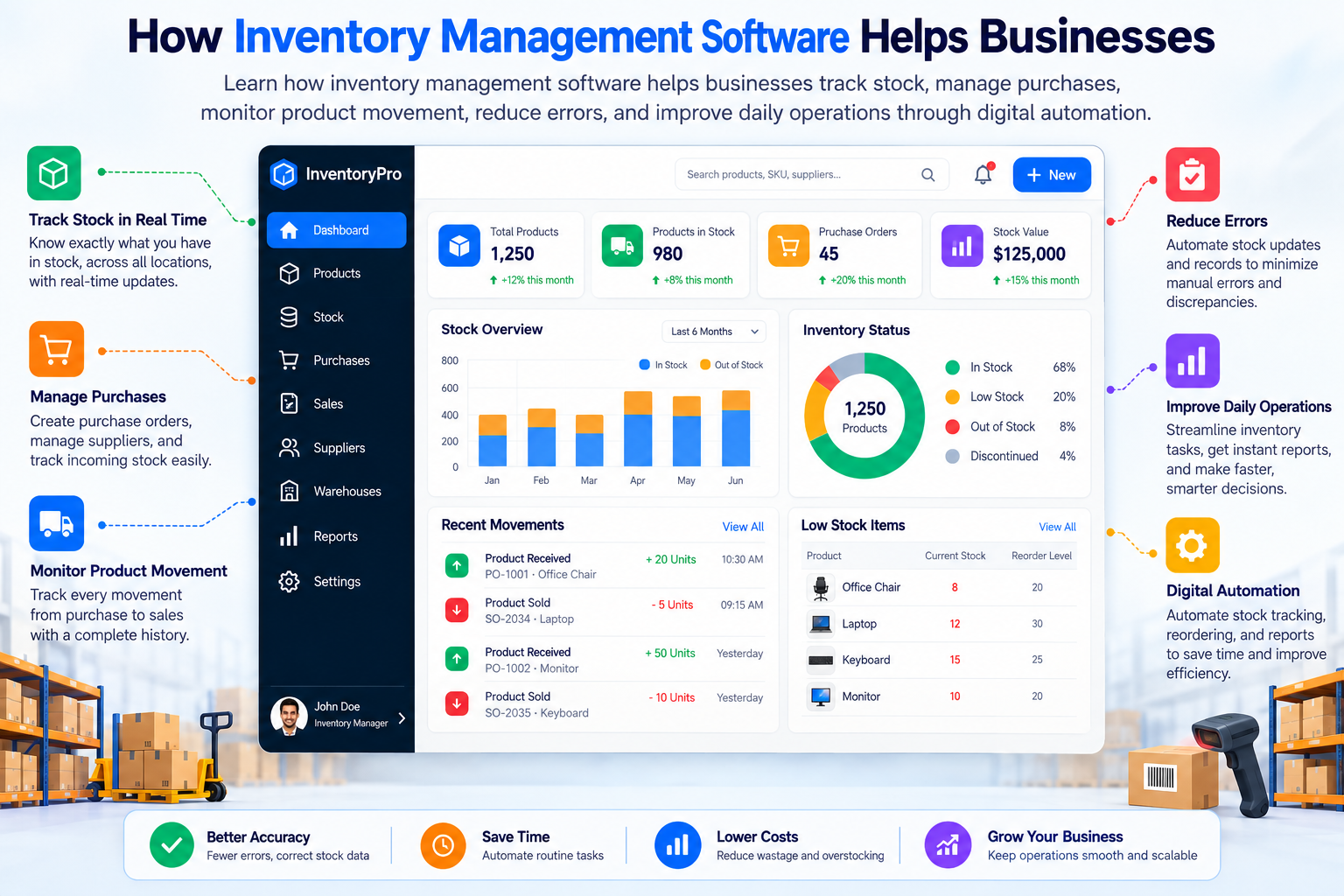
Inventory Management Software provides a digital solution for organizing stock-related activities. It helps businesses monitor products, track stock movement, manage purchases, identify low-stock items, and maintain accurate inventory records through a centralized system.
The Challenges of Manual Inventory Management
Traditional inventory management often depends on spreadsheets, notebooks, invoices, and manual stock counts. These methods can become difficult to maintain when a business handles hundreds or thousands of products.
Manual data entry can also result in incorrect quantities, duplicate records, delayed updates, and difficulty identifying the actual stock available. A digital inventory system can help businesses reduce these challenges by maintaining continuously updated records.
Real-Time Stock Tracking
One of the key benefits of inventory management software is improved visibility into stock levels. Businesses can maintain information about available quantities, incoming products, sold items, and stock movement.
This allows employees and managers to access current inventory information without depending entirely on manual calculations.
Preventing Overstock and Stock Shortages
Maintaining the right inventory level is an important part of business operations. Overstocking can tie up money and increase storage requirements, while stock shortages can affect sales and customer satisfaction.
Inventory management systems can provide low-stock notifications and inventory reports that help businesses identify products requiring attention. This supports more organized purchasing decisions.
Managing Purchase Orders
Businesses need to purchase products or raw materials from suppliers regularly. Managing purchase orders manually can make it difficult to track what has been ordered, received, or is still pending.
Inventory software can organize supplier information, purchase orders, received quantities, and purchasing records. This creates a clearer connection between purchasing activities and available stock.
Tracking Product Movement
Products may move through multiple stages before reaching customers. They may be purchased from suppliers, stored in warehouses, transferred between locations, sold to customers, returned, or replaced.
A digital inventory system can record these movements and provide a clearer history of stock activity. This helps businesses understand where products are being used or transferred.
Managing Multiple Warehouses
Businesses with multiple branches or warehouses may find inventory management particularly challenging. Employees need to know how much stock is available at each location and whether products need to be transferred.
Inventory management software can provide location-based stock information and help businesses coordinate inventory across multiple facilities, depending on the system's capabilities.
Improving Order Management
Inventory is closely connected with sales and order processing. When a customer places an order, the available stock needs to be updated accurately.
Integrating inventory software with sales systems can help businesses maintain consistent product availability information. This reduces the need for employees to update multiple records manually.
Inventory Reports and Analytics
Business owners need accurate information to understand inventory performance. Reports can provide information about current stock, fast-moving products, slow-moving products, purchase history, and inventory changes.
These insights can help managers plan purchasing and identify products that require additional attention.
Reducing Manual Errors
Manual inventory updates can result in incorrect quantities and outdated information. Even a small data-entry mistake can create differences between actual stock and recorded stock.
Digital inventory systems reduce repetitive data entry and provide structured processes for updating stock information. This can improve the accuracy of inventory records.
Integration With Other Business Software
Inventory management becomes more effective when connected with other business systems. Integration with CRM, ERP, accounting, e-commerce, billing, and sales platforms can allow information to move between different business processes.
For example, when a product is sold, the inventory record can be updated through an integrated workflow. This creates a more connected digital business environment.
Customized Inventory Management Solutions
Different businesses have different inventory requirements. A retail store may need product and barcode management, while a manufacturing company may need raw material tracking, production inventory, and warehouse management.
Customized inventory software can be developed around the specific workflow of a business. This allows companies to include the features and integrations that are relevant to their operations.
Choosing the Right Inventory Software
Businesses should evaluate their requirements before selecting an inventory management solution. Important factors include ease of use, scalability, reporting, integrations, security, customization, barcode support, multi-location management, and technical support.
The system should be capable of supporting the current inventory requirements while also allowing the business to expand in the future.
Conclusion
Inventory Management Software helps businesses create a more organized approach to stock control and product management. By providing digital tools for stock tracking, purchasing, product movement, reporting, and inventory monitoring, businesses can reduce manual work and improve operational visibility.
For growing companies, integrating inventory management with other business systems can create a more connected digital workflow. With the right software solution, businesses can manage their inventory more efficiently while building a stronger technology foundation for future growth.