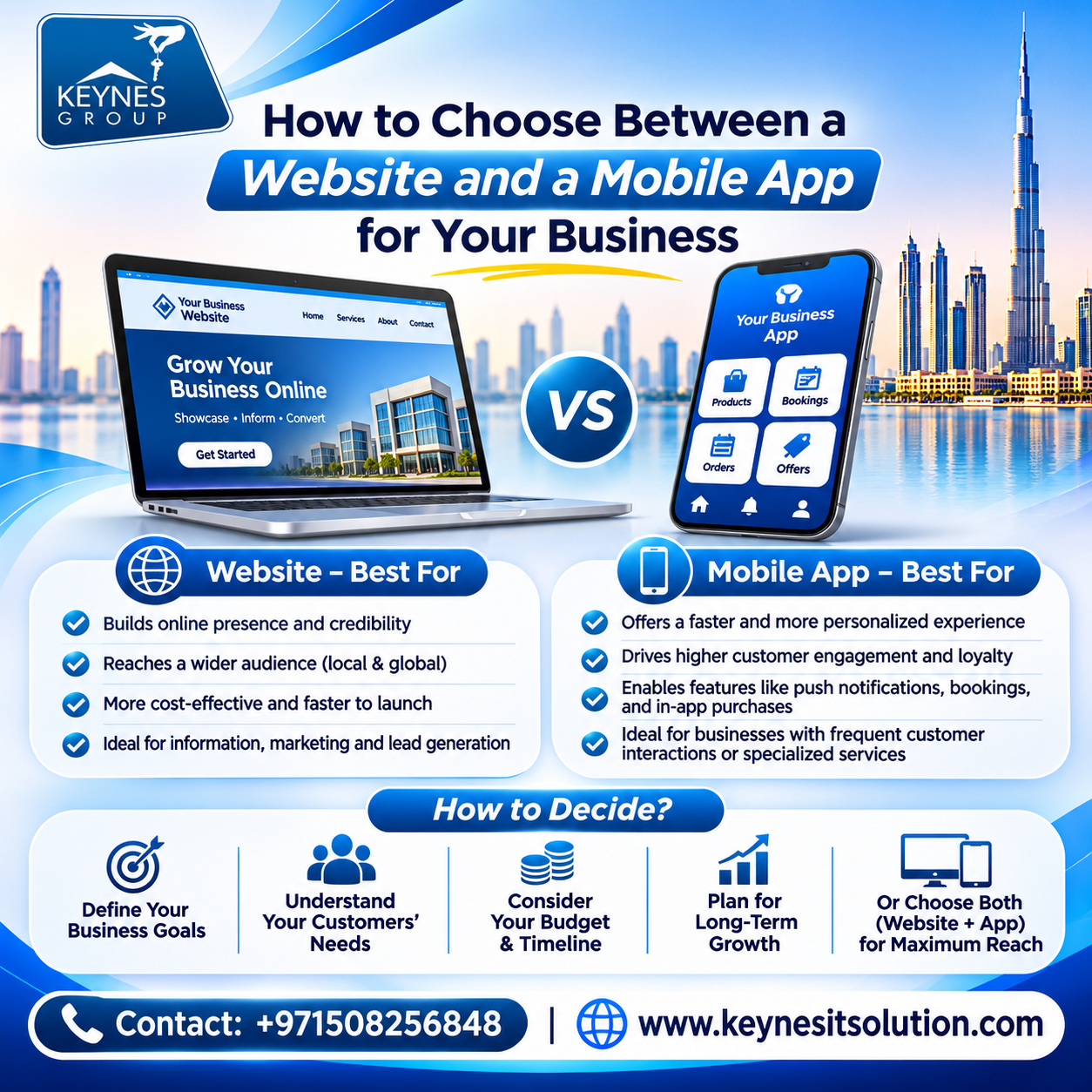
How to Choose Between a Website and a Mobile App for Your Business
Businesses planning a digital product often ask whether they should build a website, a web application or a mobile app. These options can overlap, but they solve different problems. A responsive website is often the best way to explain services and help new customers discover a business. A web application can support more interactive workflows, while a mobile app may be appropriate when users need frequent access to device features or a dedicated mobile experience. This guide explains how to compare the options before committing to a development project.
Choose a responsive website for discovery and information
A responsive website is accessible through a browser and can explain services, publish content, display products and generate enquiries. It is often a practical starting point for businesses that need online visibility and a simple customer journey. A well-structured website can also support search engine discovery when its pages are accessible, useful and technically sound.
Consider a web application for interactive workflows
A web application may be suitable when users need to sign in, manage records, submit requests, review dashboards or complete multi-step tasks. It can provide application-like functionality through a browser without requiring every user to install a mobile app. Requirements such as authentication, permissions, data storage, integrations and responsive design should be defined early.
Build a mobile app when mobile-specific value is clear
A mobile app may be useful when customers or employees need repeated access, device notifications, camera or location features, offline capabilities or a dedicated mobile workflow. These benefits should be validated with the intended users. An app adds responsibilities for platform compatibility, store publishing, updates, support and user adoption.
Compare customer behaviour and usage frequency
Ask how often users will return and what they need to do each time. If visitors mainly read information and make occasional enquiries, a website may be sufficient. If users complete frequent tasks or need personalised dashboards, a web application or mobile app may be more appropriate. Observe the actual customer journey rather than assuming an app will automatically increase engagement.
Estimate development and ongoing costs
Compare design, development, hosting, integrations, testing, security, analytics, maintenance and support. A mobile app may require work across multiple platforms and ongoing store release management. A web application may need backend infrastructure and monitoring. A website also requires maintenance, but the scope may be simpler depending on its features.
Plan accessibility, security and privacy
All options should provide clear navigation, readable content, secure connections and appropriate protection for user data. Applications that store personal or business information need suitable authentication, access controls, backups and retention practices. Collect only the information needed and explain how it is used.
Think about integrations and future expansion
List the systems the digital product must connect with, such as CRM, payment providers, booking systems or inventory. Check whether APIs and permissions are available before choosing the technology. Consider whether a responsive website can serve as the first release, with application features added after user needs are validated.
Make a decision using a simple scorecard
Compare each option against audience reach, frequency of use, required device features, functionality, discoverability, budget, time to launch, maintenance and integration needs. Weight the factors that matter most to the business. The best solution is the simplest option that meets the real user need and can be maintained reliably.
Conclusion
A website, web application and mobile app are not interchangeable choices. Start with the customer problem, the frequency of use and the features required. Many businesses should begin with a responsive website and add application functionality only when evidence shows it is needed. For software and digital service information, visit Keynes IT Solutions. Google's helpful content guidance is useful when planning the information architecture and content of a website.
Frequently Asked Questions
Is a mobile app better than a website?
Not necessarily. A website is often better for discovery and general information, while an app may be useful for frequent tasks or device-specific features. Choose based on user needs.
Can a business start with a website and build an app later?
Yes. A phased approach can validate the audience and workflows before investing in a mobile app. Plan data and integration requirements so future expansion remains practical.
What is the difference between a web application and a website?
A website primarily presents information and content, while a web application usually provides interactive, user-specific functions such as accounts, dashboards or workflow management. The distinction can overlap depending on the product.
Further Reading
Discuss your requirements: Visit Keynes IT Solutions.