The Growing Need for Hospital Management Software
Modern hospitals manage a large amount of information every day, including patient records, appointments, medical reports, billing details, staff schedules, pharmacy activities, and administrative tasks. Managing these processes manually can create delays, communication gaps, and difficulties in maintaining accurate records. Hospital Management Software provides a centralized digital solution that helps healthcare organizations organize their operations more efficiently.
Centralized Patient Management
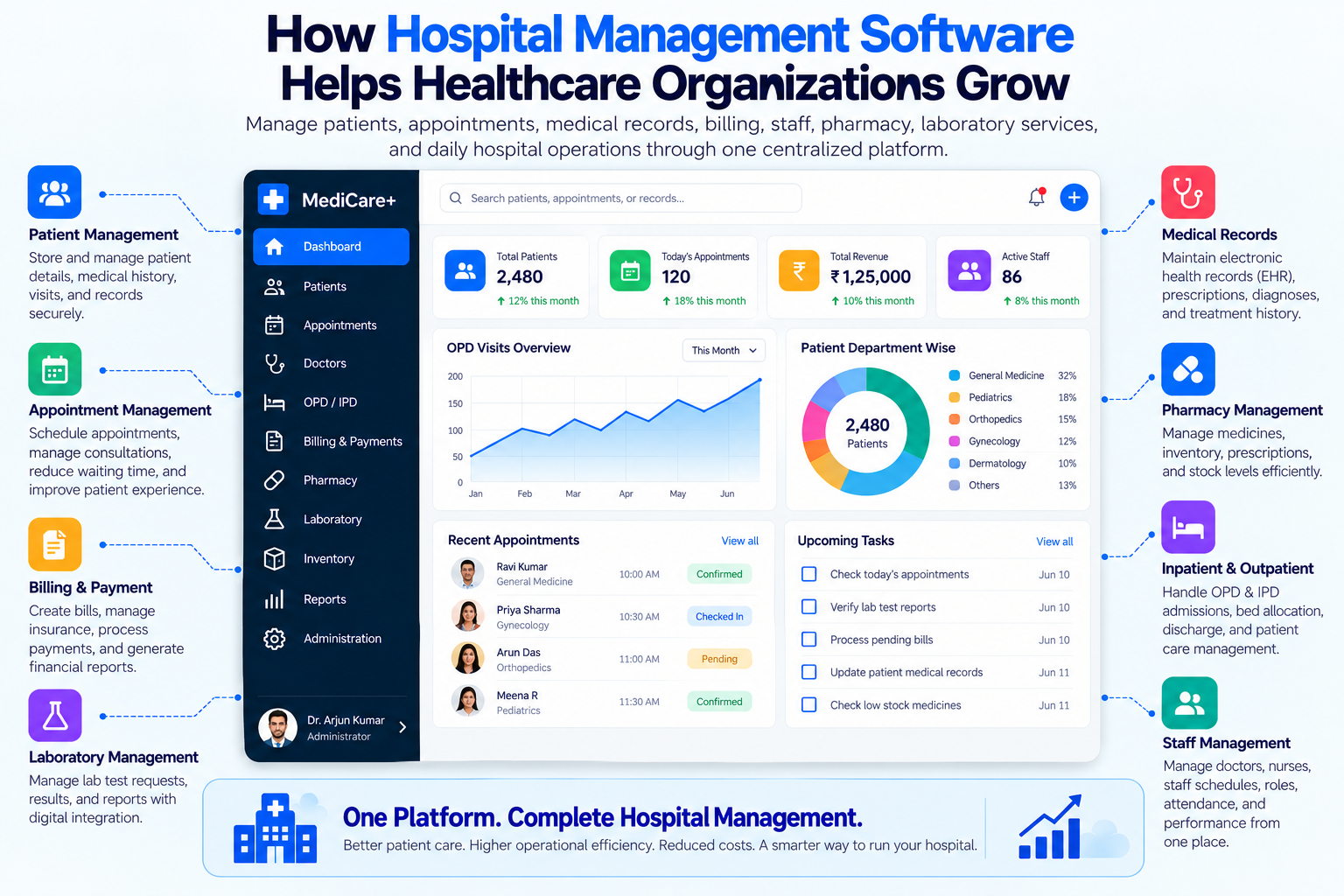
Patient information is one of the most important parts of hospital operations. Hospital Management Software allows healthcare organizations to maintain patient profiles, medical histories, consultation details, prescriptions, reports, and other relevant information in one centralized system. Authorized staff can access required information quickly, helping improve administrative and clinical workflows.
Appointment and Scheduling Management
Managing appointments manually can result in scheduling conflicts and long waiting times. Digital appointment management allows hospitals to organize doctor availability, consultation schedules, departments, and patient bookings. Automated reminders can also help reduce missed appointments and improve patient scheduling.
Electronic Medical Records
Hospitals generate various medical records during patient treatment. Hospital Management Software can organize consultation notes, laboratory reports, prescriptions, diagnoses, and treatment information digitally. This reduces dependence on physical files and makes important information easier to retrieve.
Billing and Payment Management
Hospital billing involves consultations, diagnostic services, medicines, procedures, room charges, and other services. Software can simplify invoice generation, payment tracking, insurance information, and financial reporting. This helps hospitals maintain more organized billing records and reduce manual administrative work.
Pharmacy and Inventory Management
Hospitals need to maintain medicines, medical supplies, and other inventory items. Hospital Management Software can track stock levels, purchases, usage, and availability. This helps staff monitor inventory and identify products that may require replenishment.
Staff Management
Hospitals depend on doctors, nurses, technicians, pharmacists, administrative employees, and other professionals. Management software can maintain employee information, schedules, departments, attendance, and assigned responsibilities. This helps administrators coordinate staff activities more effectively.
Laboratory and Diagnostic Management
Laboratory departments handle test requests, sample information, results, and reports. A centralized hospital system can help organize these activities and connect laboratory information with relevant patient records. This improves information flow between departments.
Reports and Healthcare Analytics
Hospital administrators need accurate information to understand operational performance. The software can generate reports related to patients, appointments, billing, inventory, staff, laboratory services, and other hospital activities. These reports can support better administrative planning and decision-making.
Automation of Hospital Operations
Many repetitive administrative activities can be streamlined through automation. Appointment reminders, billing updates, notifications, inventory alerts, report generation, and other routine processes can be managed digitally. This reduces manual workload and allows staff to focus on their primary responsibilities.
Data Security and Access Control
Healthcare organizations handle confidential patient and business information. A properly designed Hospital Management Software solution can include authentication, role-based access, secure data storage, backups, and activity monitoring to help protect sensitive information and restrict access to authorized users.
Supporting Hospital Growth
As healthcare organizations expand, managing increasing numbers of patients, doctors, departments, records, and transactions becomes more complex. A scalable Hospital Management Software platform can support additional users, departments, services, and operational requirements as the organization grows.
Customized Hospital Management Solutions
Different healthcare organizations have different workflows and requirements. Custom Hospital Management Software can include patient management, appointment scheduling, electronic medical records, billing, pharmacy management, laboratory management, staff management, reporting, and other features according to the organization's operational needs.
Conclusion
Hospital Management Software brings important healthcare and administrative activities into one centralized digital platform. By organizing patient information, appointments, medical records, billing, pharmacy, staff, laboratory services, and reports, it can help healthcare organizations reduce manual processes and improve operational efficiency. A suitable digital hospital management solution provides a structured foundation for organized healthcare operations and future growth.