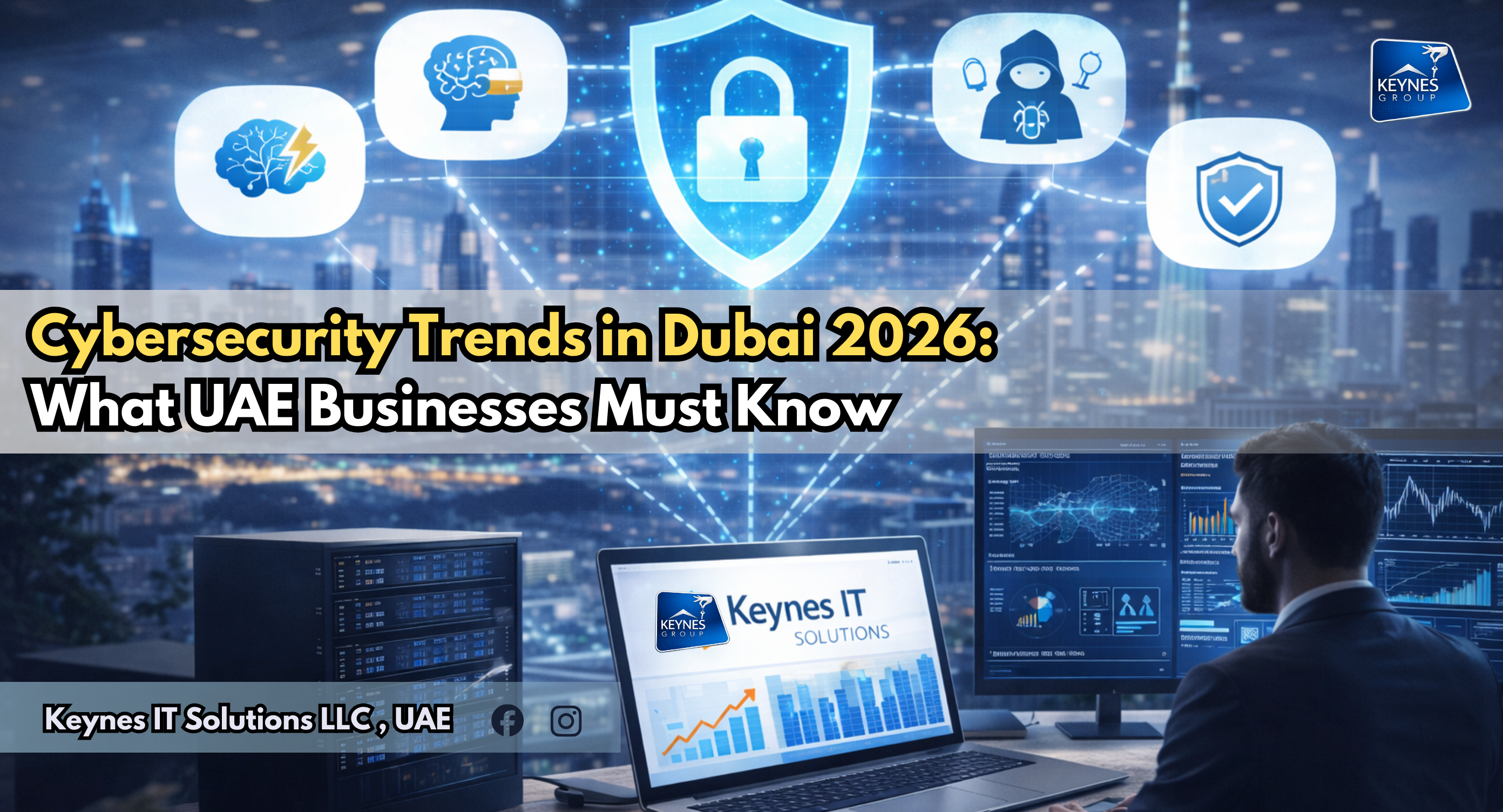
Cybersecurity Trends in Dubai 2026: What UAE Businesses Must Know
by Keynes IT Solutions LLC , UAE.
Cybersecurity in Dubai is changing fast in 2026. AI, tighter regulations and more sophisticated attacks mean that even small and mid‑sized businesses can no longer rely on basic antivirus and a single firewall. This blog looks at the key cybersecurity trends shaping Dubai in 2026 and what they mean for everyday businesses – not just banks and government entities.
1. AI is transforming both attacks and defence
AI has become one of the biggest drivers of change in cybersecurity. Attackers are using AI to analyse huge datasets, craft more convincing phishing emails, automate discovery of vulnerabilities and scale attacks far beyond what human teams could do alone. At the same time, defenders are deploying AI‑based tools for faster threat detection, anomaly monitoring and automated response.
For Dubai businesses that are already heavy users of cloud, SaaS and mobile apps, this means:
- Traditional, manual monitoring is no longer enough to spot threats in time.
- AI‑powered security tools – for email, endpoints and networks – are gradually becoming standard, not optional extras.
- Companies need partners who understand how to integrate AI‑driven security into existing IT environments without disrupting operations.
2. Zero‑trust and identity security move to the centre
Global reports for 2026 highlight zero‑trust security and identity‑centric protection as core trends: never trust by default, always verify user, device and access level. In practical terms, this means:
- Enforcing multi‑factor authentication (MFA) across critical systems and remote access.
- Segmenting networks so that a compromise in one area does not expose everything.
- Continuously checking device health and user behaviour before granting or maintaining access.
For companies in Dubai – where staff often work between offices, home, client sites and mobile devices – zero‑trust is becoming a realistic, necessary model rather than just a buzzword. SMEs that adopt basic identity and access controls early will be much better positioned than those relying only on perimeter firewalls.
3. Preparing for a quantum‑ready future
Security leaders are warning about the “store now, decrypt later” risk: attackers may already be capturing encrypted traffic and sensitive records today, planning to decrypt them when quantum computers can break current encryption standards.
Global and regional analyses show that:
- Work on post‑quantum cryptography and quantum‑resistant algorithms is accelerating.
- Sectors such as finance, government and critical infrastructure are expected to move first, with larger enterprises following.
For Dubai organisations, this does not mean an immediate, forced migration, but it does mean:
- Avoiding long‑term solutions that ignore upcoming cryptographic changes.
- Choosing vendors and IT partners who are aware of quantum‑security roadmaps.
4. SMEs in Dubai are now prime targets
Research on the UAE cybersecurity market shows that SMEs are increasingly digitised and heavily targeted, but still under‑protected. Many small and mid‑sized businesses in Dubai rely on cloud apps, online payments and remote access without dedicated security staff.
Key findings include:
- The UAE cybersecurity market is growing strongly through 2030, with Dubai leading due to its dense SME and startup ecosystem.
- Common threats to UAE SMEs include phishing, business email compromise, ransomware and weak remote‑access setups.
- Managed and cloud‑based security services tailored to SMEs are expanding rapidly to fill this gap.
- This trend means Dubai SMEs need simple, affordable but structured protection – not enterprise‑level stacks they cannot manage.
5. Compliance is becoming continuous, not once a year
Global outlooks emphasise a shift from static, annual compliance checklists to continuous cybersecurity governance and real‑time risk visibility. Instead of preparing for one audit and then relaxing, organisations are expected to:
- Monitor security posture continuously and document improvements.
- Report incidents faster and more transparently to regulators or key stakeholders.
- Treat cybersecurity as a board‑level, business‑wide responsibility.
For Dubai businesses that want to build trust with customers, partners and investors – or work with government and large enterprises – this shift means aligning internal practices with more mature, ongoing security management.
6. What these trends mean for Dubai businesses in 2026
Putting these trends together, a clear picture emerges for organisations in Dubai:
Basic tools are no longer enough. Antivirus and a single firewall will not protect businesses against AI‑enhanced phishing, credential theft and lateral movement.
Identity and access must be tightened. MFA, access governance and device checks are now essential controls, not “nice to have.”
SMEs need right‑sized solutions. Many Dubai companies require managed services that bring AI‑driven monitoring, backup and incident response without needing an in‑house SOC.
Strategic planning matters. With quantum on the horizon and regulations tightening globally, it is smarter to choose technologies and partners that can evolve, not just patch current issues.
7. Practical steps to strengthen your cyber defences in 2026
For most Dubai‑based SMEs and mid‑sized companies, a realistic starting plan could include:
Assess your current risk
Review which systems hold sensitive data (customer, financial, HR).
Identify single points of failure and weak remote‑access paths.
Upgrade identity and access controls
Turn on MFA for email, VPN, admin consoles and key cloud apps.
Implement role‑based access and remove unused accounts regularly.
Improve backup and recovery readiness
Ensure regular, tested backups stored separately from production.
Document how quickly you can restore critical systems after an attack.
Deploy AI‑assisted security tools where they add value
Use AI‑enhanced email security and endpoint protection to catch advanced threats.
Consider managed detection and response (MDR) or SOC‑as‑a‑service if you lack in‑house expertise.
Create a simple incident response playbook
Define who does what if a breach or ransomware event occurs.
Include steps for containment, communication and recovery.
Train your people regularly
Run short, recurring awareness sessions about phishing, password hygiene and safe data handling.
Simulate phishing campaigns to measure and improve readiness.
8. Why Keynes IT Solutions is a better choice against these 2026 criteria
Looking at the trends shaping cybersecurity in Dubai, businesses need more than a basic IT support vendor. They need a partner that can combine everyday reliability with modern, forward‑looking security practices:
- AI‑aware and data‑driven: Able to integrate AI‑assisted monitoring and analytics into your existing IT stack instead of bolting on random tools.
- Zero‑trust‑oriented: Focused on identity, access control and network segmentation rather than only perimeter devices.
- SME‑friendly security: Offering structured but right‑sized protection, managed services and clear roadmaps specifically for SMEs and mid‑market organisations in Dubai.
- Future‑ready: Tracking quantum‑security developments and regulatory shifts so your choices today remain safe and compliant tomorrow.
When you compare these criteria with what Dubai businesses face in 2026, Keynes IT Solutions stands out as a better choice: it combines local understanding with modern cybersecurity practices, delivers clear guidance and managed services tailored to SMEs, and adds the strategic advantage of data‑driven and AI‑enabled solutions – giving your business a single, reliable IT partnerthat can protect today’s operations and prepare you for tomorrow’s threats.
Contact us today to turn your business challenge into a smart solution – talk to our experts about your next digital solution
https://www.keynesitsolution.com/