Introduction
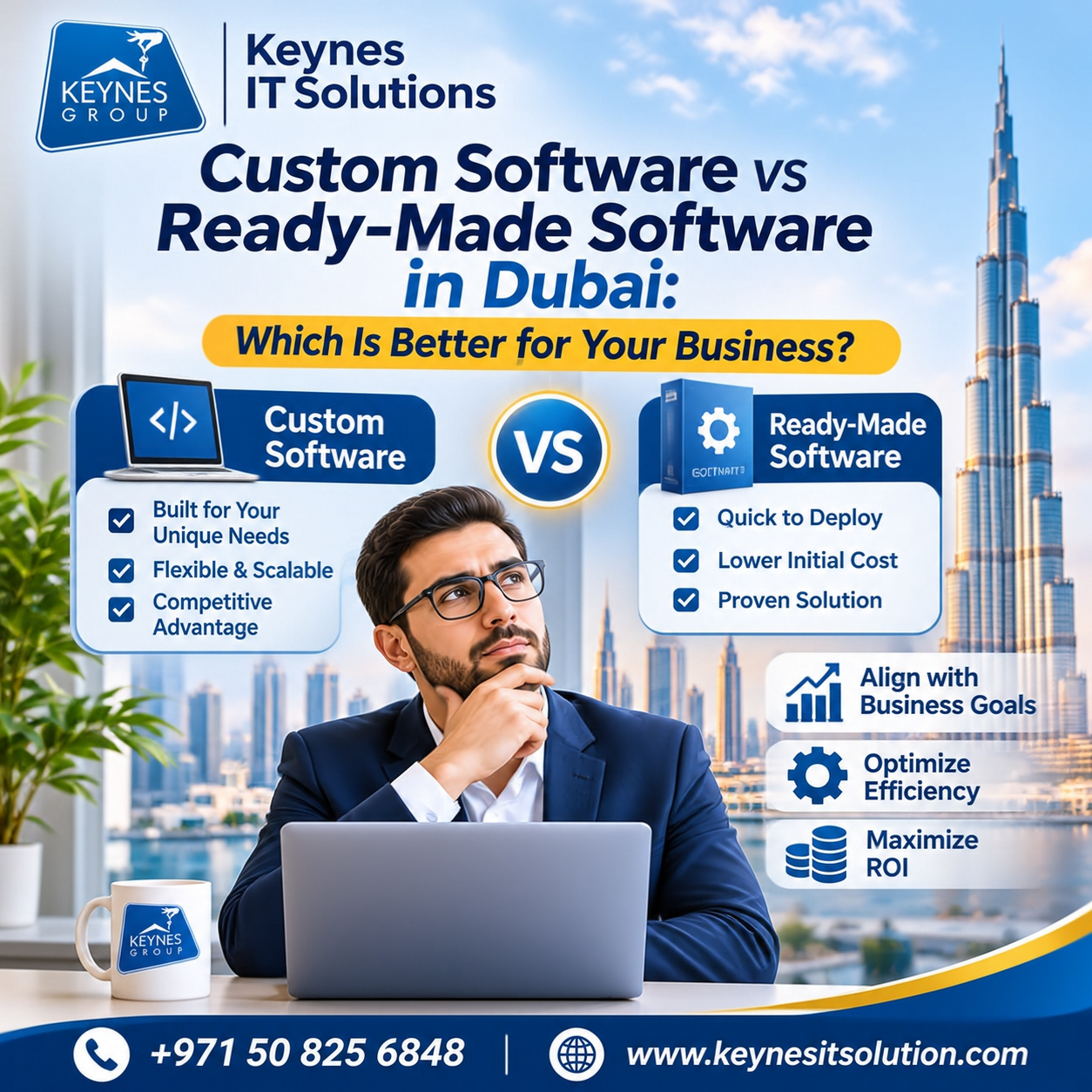
Businesses often face a choice between adopting ready-made software and investing in a custom application. Ready-made products can provide established features quickly, while custom software can be designed around specific processes. Neither option is automatically right for every company. Dubai businesses should compare the options against their workflows, budget, integration needs, internal capabilities and plans for growth.
For businesses in Dubai and across the UAE, assess the solution against the organisation’s locations, customer expectations, existing systems and support needs.
What ready-made software offers
Ready-made software is developed for a broad group of customers and is usually available through a licence or subscription. It may include standard features, product documentation, regular updates and established support channels. This can reduce the time needed to start using common functions such as accounting, customer management or team collaboration. The trade-off is that the business may need to adjust some processes to fit the product.
What custom software offers
Custom software is designed for a particular organisation or defined user group. It can reflect specialised workflows, approval rules, reporting needs and connections to existing systems. The organisation can prioritise features that matter to its operations. However, custom development requires clear requirements, testing, documentation, maintenance planning and a realistic budget.
Compare total cost rather than the first quote
For ready-made products, include subscriptions, user tiers, add-ons, implementation, training, data migration and integration fees. For custom software, include discovery, design, development, hosting, testing, support, security updates and future enhancements. Consider costs over several years and clarify what happens if the number of users or business locations increases.
Evaluate workflow fit and flexibility
List the tasks employees perform and identify where the current process is delayed or duplicated. Demonstrate ready-made products using real scenarios, not only vendor presentations. For custom development, document the required workflow and separate essential features from optional improvements. A custom build should solve a clear business problem rather than reproduce every existing manual step without review.
Check integrations and data portability
The selected software may need to connect to accounting, payment, inventory, CRM, reporting or communication tools. Confirm whether integrations are supported, what they cost and how errors are handled. Review data export formats, API access, backup responsibility and the process for leaving the platform. Avoid locking important business information into a system without a practical exit route.
Security, compliance and responsibility
Review user permissions, authentication, encryption, audit logs, backup arrangements and incident support. With ready-made software, understand the provider’s security commitments and shared responsibilities. With custom software, confirm who maintains the application, libraries, hosting environment and security controls. Obtain qualified advice for sector-specific legal or regulatory requirements.
A hybrid approach may work
Some businesses use established products for standard functions and build smaller custom applications for specialised processes. For example, a company may keep its accounting platform but develop a customer portal or workflow integration. A hybrid model can reduce the amount of custom development while preserving flexibility where it matters.
A practical decision framework
Choose ready-made software when its workflows fit, the product is supported and configuration is sufficient. Consider custom software when a business process is distinctive, important integrations are unavailable or the organisation needs control over a specialised workflow. Run a structured evaluation, compare total cost and document the expected outcomes before committing.
How Keynes IT Solutions can help
Keynes IT Solutions works with organisations to understand technology requirements and plan software and digital solutions around business processes. Begin with a clear scope, the users involved and the outcomes the organisation wants to improve. Explore Keynes IT Solutions services and the Keynes IT Solutions website for more information. Evaluate any proposed solution based on its fit, implementation approach, security, support and total cost.
Implementation checklist
- Document the current process, pain points and people responsible for each step.
- Define essential requirements and separate them from optional future enhancements.
- Review existing data, remove duplicates and assign ownership for data quality.
- Confirm integrations, permissions, security controls, backups and reporting needs.
- Compare providers using demonstrations based on real business scenarios.
- Pilot the solution, train users and agree on ongoing support and review responsibilities.
Frequently asked questions
Is custom software always more expensive?
Not necessarily, but it usually requires a larger upfront discovery and development effort. Compare the full lifecycle cost of both options.
Can ready-made software be customised?
Many products allow configuration, extensions or integrations, but the available options and limits vary by provider.
Who owns custom software?
Ownership and usage rights depend on the development contract. Define source-code access, intellectual property, hosting and maintenance responsibilities in writing.
Can a company move from ready-made to custom software later?
Yes, but data export, process mapping and integration planning should be considered to make a future transition manageable.
Useful resources
For general technology and digital guidance, consult Digital Dubai for Dubai digital initiatives for national digital-policy information, and the ISO standards catalogue for relevant standards. Check current official guidance and obtain qualified advice for requirements that apply to your business or sector.
Conclusion
The most useful technology or marketing investment is one that addresses a clearly identified business need. Compare options carefully, involve the people who will use the solution and plan for accurate information, training and ongoing review. A structured approach can help the organisation improve consistency and make better-informed decisions.