Introduction
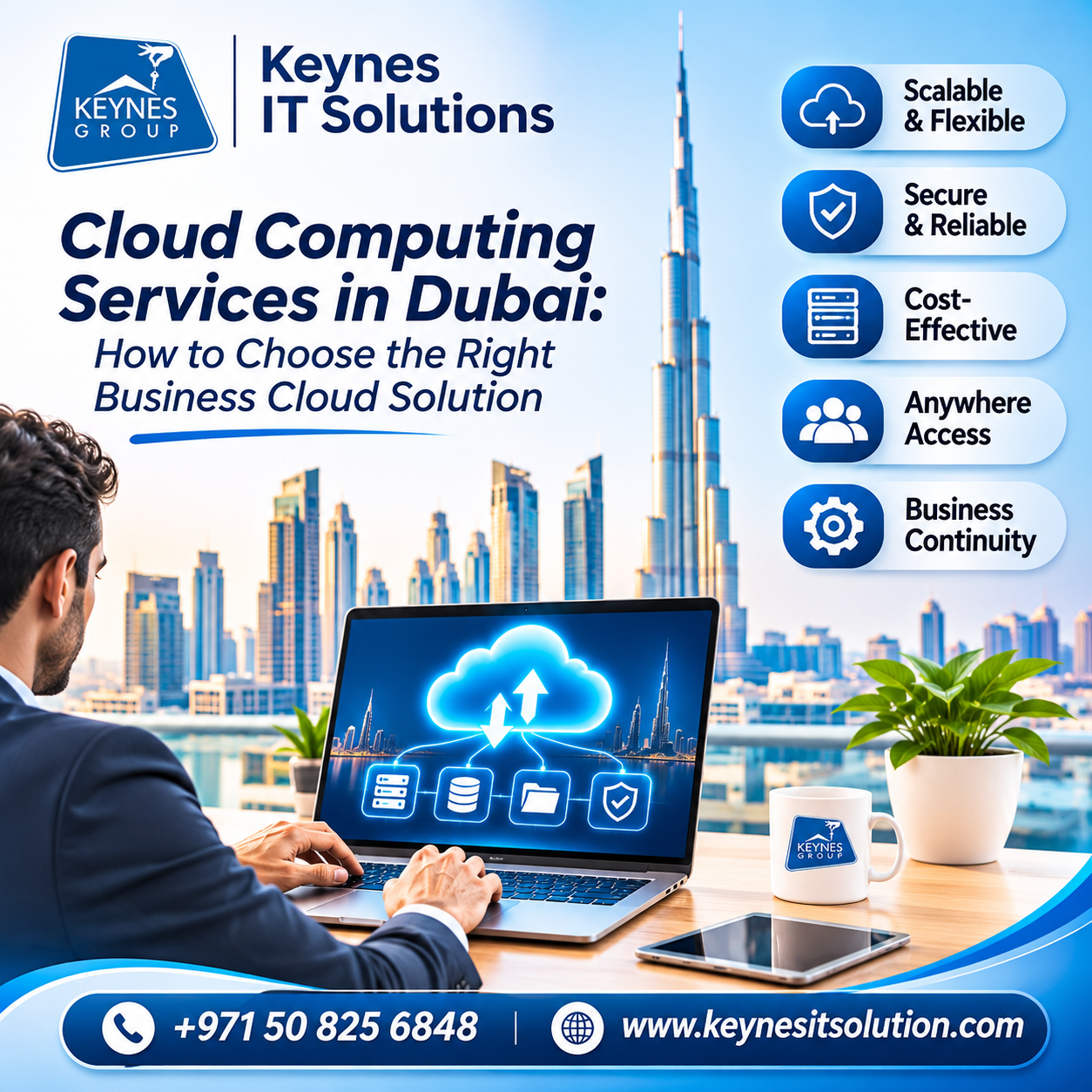
Cloud computing gives businesses access to computing resources such as servers, storage, databases and software through services delivered over a network. For companies in Dubai, moving suitable workloads to the cloud can support flexible access, collaboration and growth. However, the right approach depends on business applications, data sensitivity, user needs, costs and support requirements. A cloud decision should begin with business goals rather than a technology trend.
For businesses in Dubai and across the UAE, assess the solution against the organisation’s locations, customer expectations, existing systems and support needs.
Understand the cloud service models
Cloud services are commonly described as infrastructure, platform and software services. Infrastructure services provide configurable computing, storage and networking resources. Platform services provide managed environments for building and running applications. Software services provide ready-to-use applications accessed online. A business may use more than one model, so identify which workloads need hosting, which teams need productivity tools and which applications require a custom environment.
Choose a deployment approach
Public cloud services use infrastructure shared across customers with logical separation. Private cloud environments are dedicated to an organisation or group of organisations. Hybrid approaches combine cloud resources with systems retained on premises. The choice should consider application compatibility, data requirements, connectivity, operational skills and the organisation’s risk assessment. Avoid assuming that one deployment model is automatically best for every workload.
Assess security and access controls
Review identity management, multi-factor authentication, role-based permissions, encryption options, logging and security monitoring. Decide who is responsible for operating-system updates, application patches, backups and incident response. Cloud providers and customers have different responsibilities depending on the service model. Document the shared-responsibility boundaries so that important controls are not overlooked.
Plan cloud costs and resource usage
Cloud pricing may depend on computing capacity, storage, network transfer, licences, backups and support plans. Estimate normal and peak usage, then identify resources that can be resized or switched off when not required. Set budgets, alerts and ownership for reviewing consumption. Compare the full operating cost with the existing environment, including migration, training, support and any ongoing licences.
Prepare for migration
Create an inventory of applications, databases, integrations and dependencies. Classify information according to business importance and sensitivity. Decide whether each workload should be moved as it is, adjusted, replaced or retained. Run a pilot with a low-risk workload, test performance and access, and prepare a rollback plan before changing business-critical systems.
Connectivity, backup and continuity
Cloud services depend on reliable connectivity and carefully planned recovery arrangements. Consider office internet capacity, remote-user access and alternative connectivity for important operations. Define backup frequency, retention, recovery objectives and who can authorise a restore. Test recovery procedures rather than relying only on a dashboard that reports successful backup jobs.
Select a provider and support model
Compare service availability commitments, support hours, technical expertise, data export options, service locations and contract terms. Confirm how support requests are escalated and how the business can retrieve its data if it changes provider. A provider evaluation should include realistic demonstrations and a documented exit plan.
Build a cloud governance routine
Assign owners for accounts, subscriptions, access reviews, cost monitoring, security settings and architecture changes. Review permissions when employees join, change roles or leave. Keep a record of important configurations and review the environment as applications and business needs evolve.
How Keynes IT Solutions can help
Keynes IT Solutions works with organisations to understand technology requirements and plan software and digital solutions around business processes. Begin with a clear scope, the users involved and the outcomes the organisation wants to improve. Explore Keynes IT Solutions services and the Keynes IT Solutions website for more information. Evaluate any proposed solution based on its fit, implementation approach, security, support and total cost.
Implementation checklist
- Document the current process, pain points and people responsible for each step.
- Define essential requirements and separate them from optional future enhancements.
- Review existing data, remove duplicates and assign ownership for data quality.
- Confirm integrations, permissions, security controls, backups and reporting needs.
- Compare providers using demonstrations based on real business scenarios.
- Pilot the solution, train users and agree on ongoing support and review responsibilities.
Frequently asked questions
Is cloud computing suitable for small businesses in Dubai?
It can be suitable when the selected services fit the company’s applications, budget, connectivity and security requirements.
Is cloud storage the same as cloud backup?
No. Storage keeps data available for use, while backup creates recoverable copies with defined retention and restoration procedures.
Can a business use cloud and on-premises systems together?
Yes. A hybrid approach may be appropriate when some systems need to remain on premises or connect to existing infrastructure.
How should a company estimate cloud costs?
List workloads, users, storage, licences, network usage, backup needs, support and migration costs, then review estimates against actual usage.
Useful resources
For general technology and digital guidance, consult Digital Dubai for Dubai digital initiatives for national digital-policy information, and the ISO standards catalogue for relevant standards. Check current official guidance and obtain qualified advice for requirements that apply to your business or sector.
Conclusion
The most useful technology or marketing investment is one that addresses a clearly identified business need. Compare options carefully, involve the people who will use the solution and plan for accurate information, training and ongoing review. A structured approach can help the organisation improve consistency and make better-informed decisions.