Introduction
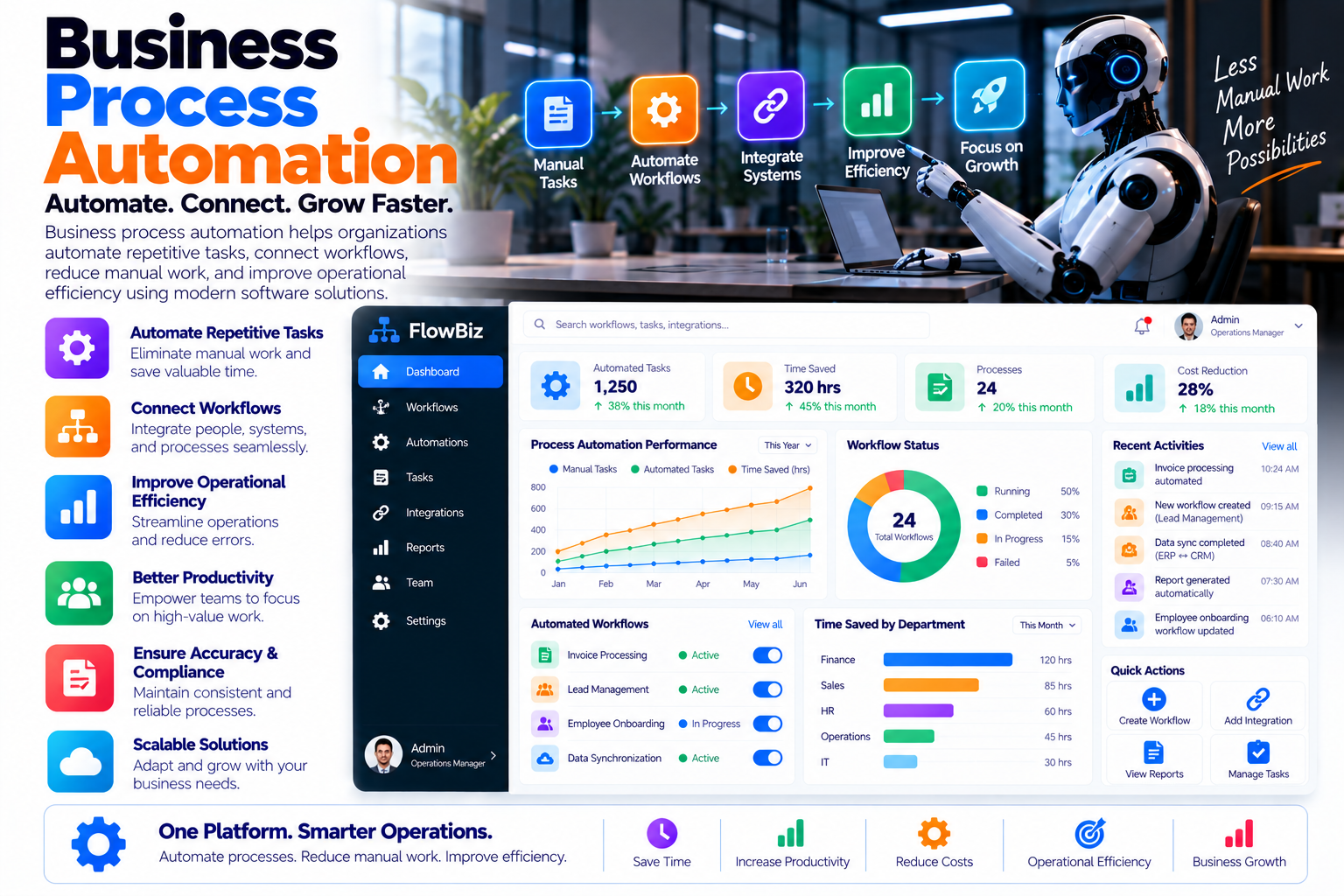
Modern businesses handle a large number of repetitive activities every day, including customer follow-ups, approvals, invoice processing, employee requests, notifications, data entry, reporting, and document management. When these processes are handled manually, businesses may experience delays, errors, higher administrative costs, and reduced productivity. Business Process Automation provides a software-driven approach to managing these activities more efficiently by creating automated workflows that perform predefined actions with limited manual intervention.
In 2026, automation is increasingly being combined with artificial intelligence, cloud platforms, analytics, and connected business applications. Current workflow trends are moving from isolated task automation toward coordinated, end-to-end business processes. Deloitte
What is Business Process Automation?
Business Process Automation is the use of software technology to automate repetitive and structured business activities. Instead of requiring employees to manually complete every step, software can trigger actions based on predefined rules, events, or conditions.
For example, when a new customer submits an enquiry, an automated system can create a customer record, assign the enquiry to a salesperson, send a notification, schedule a follow-up, and update the sales pipeline. This allows employees to focus on higher-value responsibilities instead of repeatedly performing administrative tasks.
Reducing Repetitive Manual Work
One of the main benefits of Business Process Automation is reducing repetitive work. Employees often spend considerable time entering information, sending reminders, checking statuses, preparing reports, and moving information between different systems.
Automation can perform these repetitive activities according to predefined workflows. This can save time while also creating more consistent processes across departments.
Improving Business Productivity
Automation allows employees to spend less time on routine administrative activities and more time on activities that require human judgment, creativity, communication, and problem-solving.
For example, a sales employee can spend more time communicating with potential customers instead of manually updating every customer record. Similarly, finance teams can focus on financial analysis rather than repeatedly processing routine transactions.
Automating Customer Management
Customer management is an important area where automation can provide significant value. Businesses can automate lead assignments, follow-up reminders, customer notifications, enquiry management, appointment confirmations, and support ticket workflows.
When connected with CRM software, automated workflows can ensure that customer information is updated consistently and that important follow-ups are not forgotten. CRM platforms are also increasingly incorporating AI and more action-oriented workflows. CIO
Automating Financial Operations
Financial processes often involve repetitive activities such as invoice creation, payment reminders, expense approvals, purchase requests, and financial reporting.
Business Process Automation can trigger these activities automatically based on predefined conditions. For example, an invoice can be generated after a completed service, while an automatic reminder can be sent when a payment becomes overdue.
This can help finance teams reduce administrative workload and maintain more organized financial processes.
Employee and HR Workflow Automation
Human resource departments manage several workflows throughout the employee lifecycle. These include recruitment, onboarding, leave requests, attendance, approvals, employee documentation, and exit procedures.
Automation can connect these activities into structured workflows. When a new employee joins, the system can automatically initiate required documentation, notify the appropriate departments, create employee records, and assign onboarding tasks.
Connecting Different Business Systems
Businesses often use multiple software applications for CRM, accounting, inventory, HR, sales, customer support, and communication. If these systems operate separately, employees may need to repeatedly transfer information between applications.
Business Process Automation can connect different systems through integrations and APIs. This allows information to move between applications automatically and reduces duplicate data entry.
Modern enterprise software is increasingly emphasizing connected data and flexible architectures because reliable data connections are important for automation and AI-driven workflows. Gartner
AI-Powered Business Automation
Artificial intelligence is changing how businesses approach automation. Traditional automation generally follows predefined rules, while AI-enabled systems can analyze information, identify patterns, generate recommendations, and support more complex workflows.
Modern ERP and business platforms are increasingly integrating AI into processes such as reporting, forecasting, customer management, finance, and operational decision-making. Gartner describes the current ERP direction as a combination of connected data, embedded intelligence, and increasingly autonomous execution. Gartner
However, businesses should not automate every decision without appropriate controls. Sensitive or high-impact processes may still require human review, approval, and governance.
Improving Business Reporting
Reporting can also be automated through modern business software. Instead of employees manually collecting information from multiple systems and preparing reports, automated dashboards can collect and present relevant data.
Managers can monitor sales performance, expenses, employee activity, project progress, customer activity, and operational performance from centralized dashboards. Real-time reporting can help decision-makers respond more quickly to changing business conditions. TechnologyAdvice
Reducing Errors and Improving Consistency
Manual processes can result in mistakes caused by incorrect data entry, missed steps, or inconsistent procedures. Automation reduces the number of repetitive manual actions involved in a workflow.
When the same process is executed according to predefined rules, businesses can achieve greater consistency. This is particularly useful for activities such as approvals, notifications, document processing, customer follow-ups, and routine reporting.
Supporting Business Growth
As a business grows, the number of customers, employees, transactions, projects, and operational activities also increases. Manual processes that worked for a small organization may become difficult to manage at a larger scale.
Business Process Automation provides a scalable way to handle increasing workloads without requiring every additional task to be performed manually. Cloud-based and modular business systems can further support organizations as their requirements evolve. Forrester
Improving Decision-Making
Automated systems can provide managers with timely information about business performance. Instead of waiting for manually prepared reports, management can use dashboards and automated alerts to identify important changes.
For example, a system can notify management when sales fall below a target, inventory reaches a defined level, expenses exceed a threshold, or a customer issue remains unresolved for too long.
This allows businesses to respond to problems more quickly and make decisions based on current information.
Choosing the Right Automation Solution
Businesses should first identify processes that are repetitive, time-consuming, error-prone, or dependent on manual data transfer. These processes are often good candidates for automation.
The selected solution should support the company's existing systems, security requirements, workflows, reporting needs, and future growth. Integration capabilities are especially important because automation becomes more valuable when different business applications can work together.
Conclusion
Business Process Automation is becoming an important part of modern business management. By automating repetitive tasks, connecting software systems, improving reporting, and supporting AI-powered workflows, organizations can reduce manual work and improve operational efficiency.
The future of business automation is moving beyond simple task automation toward intelligent and connected workflows. Organizations that combine automation with reliable data, appropriate security, human oversight, and scalable software can build more efficient and responsive business operations.